Комбіноване рознесення сигналів для Фішер-Снедекор композитної моделі завмирання при наявності завад
DOI:
https://doi.org/10.20535/S0021347023070014Ключові слова:
SC рознесення, перешкода, затухання, затіненняАнотація
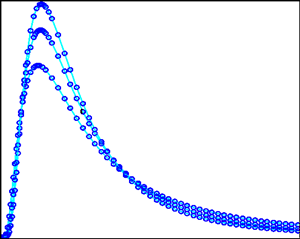
В статті представлено характеристики моделі завмирання з Фішер–Снедекор (F) розподілом для забезпечення комбінованого рознесення сигналів SC (selection combining) в обмеженій системі під дією завад. Приведені функція щільності ймовірності PDF (probability density function) і кумулятивна функція розподілу CDF (cumulative distribution function) без SC рознесення при заваді від одного користувача. Також розраховано вирази CDF і PDF при використанні SC рознесення. PDF представлено для різних комбінацій параметрів корисних сигналів та параметрів багатопроменевого завмирання сигнала перешкод. Результати також проілюстровано в залежності від ймовірності порушення зв’язку OP (outage probability) як для незалежних, але не обов’язково ідентично розподілених INID (independent but not necessarily identically distributed), так і для незалежних ідентично розподілених IID (independent identically distributed) каналів. Краща характеристика ОР забезпечується при більшій кількості гілок рознесеного прийому.
Посилання
- P. M. Shankar, Fading and Shadowing in Wireless Systems. New York, NY: Springer New York, 2012, doi: https://doi.org/10.1007/978-1-4614-0367-8.
- S. K. Yoo, S. L. Cotton, W. G. Scanlon, G. A. Conway, “An experimental evaluation of switched combining based macro-diversity for wearable communications operating in an outdoor environment,” IEEE Trans. Wirel. Commun., vol. 16, no. 8, pp. 5338–5352, 2017, doi: https://doi.org/10.1109/TWC.2017.2709298.
- B. Sharma, D. Koundal, “Cattle health monitoring system using wireless sensor network: a survey from innovation perspective,” IET Wirel. Sens. Syst., vol. 8, no. 4, pp. 143–151, 2018, doi: https://doi.org/10.1049/iet-wss.2017.0060.
- A. Kumar, S. Sharma, N. Goyal, A. Singh, X. Cheng, P. Singh, “Secure and energy-efficient smart building architecture with emerging technology IoT,” Comput. Commun., vol. 176, pp. 207–217, 2021, doi: https://doi.org/10.1016/j.comcom.2021.06.003.
- G. Femenias, “MGF-based performance analysis of selection diversity with switching constraints in nakagami fading,” IEEE Trans. Wirel. Commun., vol. 5, no. 9, pp. 2328–2333, 2006, doi: https://doi.org/10.1109/TWC.2006.1687752.
- P. Bithas, P. Mathiopoulos, S. Kotsopoulos, “Diversity reception over generalized-K (KG) fading channels,” IEEE Trans. Wirel. Commun., vol. 6, no. 12, pp. 4238–4243, 2007, doi: https://doi.org/10.1109/TWC.2007.4400789.
- P. Theofilakos, A. Kanatas, G. Efthymoglou, “Performance of generalized selection combining receivers in K fading channels,” IEEE Commun. Lett., vol. 12, no. 11, pp. 816–818, 2008, doi: https://doi.org/10.1109/LCOMM.2008.080779.
- T. Bhaskar Reddy, R. Subadar, P. Sahu, “Outage probability of SC receiver over exponentially correlated K fading channels,” IEEE Commun. Lett., vol. 14, no. 2, pp. 118–120, 2010, doi: https://doi.org/10.1109/LCOMM.2010.02.091749.
- S. Khatalin, “Performance of dual-branch selection combining diversity systems in non-identical Nakagami-q (Hoyt) fading channels,” IET Commun., vol. 4, no. 5, p. 585, 2010, doi: https://doi.org/10.1049/iet-com.2009.0445.
- R. Subadar, A. D. Singh, “Performance of SC receiver over TWDP fading channels,” IEEE Wirel. Commun. Lett., vol. 2, no. 3, pp. 267–270, 2013, doi: https://doi.org/10.1109/WCL.2013.13.120778.
- A. D. Singh, R. Subadar, “Capacity analysis of M-SC receivers over TWDP fading channels,” AEU - Int. J. Electron. Commun., vol. 68, no. 2, pp. 166–171, 2014, doi: https://doi.org/10.1016/j.aeue.2013.08.001.
- A. Abdi, M. Kaveh, “K distribution: an appropriate substitute for Rayleigh-lognormal distribution in fading-shadowing wireless channels,” Electron. Lett., vol. 34, no. 9, p. 851, 1998, doi: https://doi.org/10.1049/el:19980625.
- H. Al-Hmood, H. S. Al-Raweshidy, “Selection combining scheme over non-identically distributed Fisher-Snedecor F fading channels,” IEEE Wirel. Commun. Lett., vol. 10, no. 4, pp. 840–843, 2021, doi: https://doi.org/10.1109/LWC.2020.3046519.
- E. A. Neasmith, N. C. Beaulieu, “New results on selection diversity,” IEEE Trans. Commun., vol. 46, no. 5, pp. 695–704, 1998, doi: https://doi.org/10.1109/26.668745.
- M.-S. Alouini, M. K. Simon, “An MGF-based performance analysis of generalized selection combining over Rayleigh fading channels,” IEEE Trans. Commun., vol. 48, no. 3, pp. 401–415, 2000, doi: https://doi.org/10.1109/26.837044.
- J. P. Pena-Martin, J. M. Romero-Jerez, C. Tellez-Labao, “Performance of selection combining diversity in η–μ fading channels with integer values of μ,” IEEE Trans. Veh. Technol., vol. 64, no. 2, pp. 834–839, 2015, doi: https://doi.org/10.1109/TVT.2014.2326333.
- S. R. Panić, M. C. Stefanović, A. V. Mosić, “Performance analyses of selection combining diversity receiver over α–μ fading channels in the presence of co-channel interference,” IET Commun., vol. 3, no. 11, p. 1769, 2009, doi: https://doi.org/10.1049/iet-com.2009.0023.
- R. Annavajjala, A. Chockalingam, L. B. Milstein, “Performance analysis of coded communication systems on Nakagami fading channels with selection combining diversity,” IEEE Trans. Commun., vol. 52, no. 6, pp. 1030–1030, 2004, doi: https://doi.org/10.1109/TCOMM.2004.829502.
- R. Subadar, P. Das, “Performance of L-SC receiver over K-fading channels,” in 2017 8th International Conference on Computing, Communication and Networking Technologies (ICCCNT), 2017, pp. 1–4, doi: https://doi.org/10.1109/ICCCNT.2017.8203908.
- S. K. Yoo, S. L. Cotton, P. C. Sofotasios, M. Matthaiou, M. Valkama, G. K. Karagiannidis, “The Fisher–Snedecor F distribution: A simple and accurate composite fading model,” IEEE Commun. Lett., vol. 21, no. 7, pp. 1661–1664, 2017, doi: https://doi.org/10.1109/LCOMM.2017.2687438.
- A. Singh, H. Shankar, “MGF based analysis of interference limited system over Fisher-Snedecor fading channels,” in 2022 International Conference on Signal and Information Processing (IConSIP), 2022, pp. 1–4, doi: https://doi.org/10.1109/ICoNSIP49665.2022.10007510.
- M. K. Alshawaqfeh, O. S. Badarneh, F. S. Almehmadi, “Performance analysis of digital transmission in interference-limited networks,” Telecommun. Syst., vol. 79, no. 2, pp. 233–247, 2022, doi: https://doi.org/10.1007/s11235-021-00854-2.
- А. Бора, А. Хусейн, Д. Бора, “Анализ выравнивания помехи на основе предварительного кодирования многопользовательской системы MIMO,” Известия вузов. Радиоэлектроника, vol. 64, no. 11, pp. 705–712, 2021, doi: https://doi.org/10.20535/S0021347021110054.
- В. Нур Мохамед, Н. Срината, П. Ш. Малик, Л. Нитянандан, “Параллельное подавление помех в MC-CDMA приемнике с пространственно-временным блочным кодированием,” Известия вузов. Радиоэлектроника, vol. 60, no. 11, pp. 628–639, 2017, doi: https://doi.org/10.20535/S0021347017110036.
- I. S. Gradshteyn, I. M. Ryzhik, Table of Integrals, Series, and Products, 7th ed. Academic Press, 2007, uri: https://www.academia.edu/36550954/I_S_Gradshteyn_and_I_M_Ryzhik_Table_of_integrals_series_and_products_Academic_Press_2007_.
- A. P. Prudnikov, Y. Brychkov, O. I. Marichev, Integrals and Series. Volume 3: More Special Functions. New York-London: Gordon and Breach, 1989.